Saturday, March 20, 2010

The Origin of Government Intervention Part 1: National Security


The bailouts of General Motors and Wall Street banks stirred a hornets' nest. Advocates of limited government have decried these actions as the inevitable consequences of government interference in the economy. Proponents of active government, on the other hand, argue that the process of federal deregulation enabled GM and certain commercial banks to become 'too big to fail,' allowing those corporations to hold the economy hostage. The question is: who's right?

Well, as I argued in my previous article [1], a constructive answer requires us to ditch the ideological nonsense. And to that end, I wish to dedicate the content of this article to discussing an aspect of economics that seems to escape most mainstream debate in the US: the relationship between economic policy and national security. If we are to understand how ideas of government intervention entered into American political discourse, we must start by examining the international position of the US after the Revolution.

When the American colonies were thrust upon the world stage as independent states in 1783, the international system was—as it still is today—defined by anarchy (a lack of world government). This particular form of international relations has specific consequences for the internal composition of states, especially as it pertains to the relationship between government and the private sector.

With no recourse to an authority above themselves to settle disputes, an anarchic international order forces all states to provide for their own security. This requires the establishment of individual military institutions and the requisite means to support them. Support, in this context, entails a sustainable access to sufficient capital to fund the operations of military units, farms to feed them, factories to produce clothing and equipment, and raw materials to supply the factories. All of this, of course, is in addition to the needs of the domestic markets of each state.

Because power is not distributed equally among actors in a state of anarchy, all governments find themselves in a perpetual contest for strategic advantages. This competition creates what is known as the security dilemma: a situation in which any increase in the security of one state is a direct threat to the security of other states in the system. So if, for instance, nation A expands the size of its military forces or seizes territory rich in natural resources it lacks, nations B, C, and D are forced to counteract these potentially destabilizing moves. This is achieved by either forming an alliance against nation A or pursuing individual policies that bring each of them into parity with it. If equilibrium is not reached between these actors, the more powerful state (nation A) will be able to pursue its interests at the expense of the security of B, C, and D.

Separation from Great Britain left the US ill-prepared to compete in this cutthroat world of power politics. The American economy was largely agrarian, dependent upon factories and banks in Europe (mainly Great Britain) to supply them with manufactured goods and liquid capital. This arrangement was largely the product of the British approach to colonialism. In theory, the mother country and its colonies were bound together in a symbiotic relationship, each supplying the other with the materials it lacked. However, in practice the American colonies needed the mother country far more than it needed them.

North America was but one source among many from which the British government could obtain raw materials for its domestic market. American colonists, on the other hand, could only obtain manufactured goods and loans from Great Britain. While one reason for this relationship had to do with British laws that restricted trade outside the empire, the reality was that Britain had the world's premier industrialized economy.

Information on factory machinery was a closely guarded state secret and individuals with this specialized knowledge were prevented from traveling abroad. Furthermore, the British government had access to public credit through a national bank, enabling it to subsidize private institutions it deemed vital to its security. These measures, combined with exclusive access to raw materials from its colonies, gave the British Empire a virtual monopoly on industrial production which, in turn, made it a formidable military juggernaut.

It was with this picture of international relations in mind that Alexander Hamilton described the state of US security in his Report on Manufactures (1790). A constant and increasing demand on the part of American states, he writes,

for the commodities of Europe, and only a partial and occasional demand for their own, in return, could not but expose them to a state of impoverishment(...)the regulations of several countries, with which we have the most extensive intercourse, throw serious obstructions in the way of the principle staples of the United States. [2]

In other words, by striking out on their own, the United States were outside the government-supported industrial system which had made American society possible. As a result, "obstructions" to trade--such as tariffs and colonial monopolies--designed to maximize the economic security of Great Britain, were now undermining the American economy. This problem was compounded by the protectionist policies of other powerful European countries.

This brings us to the heart of this discussion. In an international system where powerful states can renege on agreements with impunity and take what they want by force, it is suicidal for a weaker state to place its economic security at the mercy of stronger ones. In the 18th and 19th centuries, the US was very weak indeed. Without sources of capital investment and industrial production which was free from foreign interference, Americans would be unable to field and maintain military forces comparable to those of Europe.

As a consequence, if the US ever ran afoul of its European competitors, the economic obstructions mentioned above and the military capabilities they afford would be used to bully the United States into subservience. In such a context, only a reasonable level of economic self-sufficiency could enable Americans to retain their sovereignty. In part 2 of this series, I will expand upon this logic by examining the relationship between the urgent need for industrialization in the US and early government intervention in the American economy

Read more...

Friday, March 5, 2010

Chasing Phantoms: a comment on ideology


Familiarity and habit, even in the worst social environments, bring with them an endearing level of predictability to human interaction (better the devil you know). As such, there is a tendency to view social or political change as an all or nothing endeavor--either "our" side prevails and the system is saved or "we" are defeated, ensuring the onset of a new Dark Age. When the latter is perceived to be the case, it is often blamed on weak-willed turncoats and sinister opponents with no regard for the sanctity of the established order.

Of course, the world, to say nothing of politics, would be infinitely easier to understand if it did indeed operate in this manner. But alas, it rarely does. Conspiracies are almost never vast and few dissenters live up to their "Dick Dastardly" caricatures. Moreover, although there will always be fools and knaves, partisan fervor tends to grossly overestimate their number and influence.

Which brings us to the heart of modern political conflict in the United States: an excessive reliance on ideology. To surrender the exercise of one's reason to the will of party or ideology is to commit oneself to an intellectually shallow concept of human motives. For the very aspect which makes ideological principles easy to grasp through talking points, cable news, and talk radio echo chambers, is also what prevents adherents from understanding the difficulties of turning generalities into specific policy initiatives. That is to say, avoidance of the details of governance can lead one to equate skepticism with disloyalty or to demonize the underlying motives of competing ideas

The educated in this country have, in recent decades, increasingly fallen victim to such misguided suspicion. The academic emphasis on critical thinking--even when it is focused on refining a particular idea for the better--can lead to cries of "America hater", "Nazi" or "socialist". Yet, disagreement over particular ideas does not automatically place one in the camp of radical opposition. Such knee-jerk aspersions are inconsistent with the basic tenants of rational debate and unbecoming of any individual who wishes to have his or her own ideas taken seriously.

It is folly to presume that the US has nothing to learn from other countries, political systems, or ideological perspectives. The taking of specific ideas from either of these sources does not entail a complete and irrevocable conversion. ALL existing governments, including the one outlined in the US Constitution, are syntheses of competing political ideas. You simply could not have the hybrid system known as federalism without the opposing views of Jefferson and Hamilton; nor could you have those giants of the Revolution without the competing philosophical influences of Hobbes and Rousseau, and so on.

As a consequence, to assume that political purity is a precondition for effective government is to embark upon a crusade for a world that never was, and never will be. Searching for evil phantoms and dupes to rationalize the failure of society to embrace a singular ideological perspective is equally quixotic. For in the final analysis, the devil is in the details; complex societies can only be understood within the context of equally complex explanations.

Read more...

Friday, October 30, 2009

A British perspective on federalism, Empire and the European Union.

Having read with great interest the articles here about the development of federalism in the United States of America, I thought that a comparison with the development of European federalism would complement these articles, comparing the development of the European Union with that of the American federation.

I will first declare my allegiance and political persuasion. I am an English Tory, who lives in Wales. I share the belief with the neo-federalists that power is too centralised. Not just within Europe but within the British Union as well (although there is some decentralisation with the Scottish Parliament and the assemblies in Wales and Northern Ireland, England has been left out of this entirely). The developments within the UK are for a different article though as they concern the devolution of power from a former unitary state and not the rebalancing of power between a central authority created by formerly independent entities, as is the case with the European Union and the American Union.

To successfully rebalance power, an understanding is needed as to the nature of the current power structure. What genuine power do each of the entities possess? I am not referring to the constitutional details here, but something more fundamental. The English County Councils could be abolished by an Act of Parliament and there is nothing the councillors could do about it. An incoming Conservative Government could probably legislate away the Welsh assembly without too many dire consequences for central government and its control of Wales. The abolition of the Northern Ireland assembly would provoke protests from the Republic of Ireland government and a return to sectarian violence. An attempt to abolish the Scottish Parliament might provoke a unilateral declaration of independence. Whether the Scottish people and the Scottish regiments of the British army would follow Hollyrood or Westminster in such an event is unclear. They would be probably more likely to follow Hollyrood. However, a unilateral declaration of independence by an SNP government without any provoking action from Westminster may produce a different result. To take this idea further, we should consider what may seem an absurd idea - whether the EU could abolish the British Parliament. If the British Government said no, there would be no way the EU could enforce such an action. The EU could not prevent a British breakaway from Europe by force but there is the issue of the economic consequences of a withdrawal – this needs to be analysed in depth and a simple conclusion for an introductory section is not possible. This power over Britain is still very real however. It is clear that we have a range of real power in the smaller units of government from the virtually powerless to a situation where there is real division of power.

The issue of where real power lies is deeply tied up with ideas of identity and legitimacy of government, economic power and military power. In both the American and European Unions, real power has shifted to the central authority, not merely the consensual sharing of decision making. In order to understand how it may be possible to reverse this process, it is necessary to analyse how this situation arose and the real power structure, including the strengths and weaknesses of the constituent bodies. It is easy to see how the English county councils have little power and likewise the Welsh assembly - both were created by statutes of the Westminster Parliament, but what about the transfer of power between formally sovereign bodies?
In this first article, the development of the European Union will be discussed.

Different perspectives on the European Federalism

It will of course be necessary to do this from two very different perspectives, British and Continental. Many people outside of the UK will not appreciate just how controversial what I have written in the first paragraph is. The EU aim of a federal European state is widely recognised on the continent, even if disliked by more people than the powers that be would like to admit. In this island, the federal aim is political dynamite and a massive factor in the fall of the last Conservative Government. Pro-Europeans will usually deny that a federal super-state is the objective and will dismiss Euro-sceptics warnings about a super state as paranoia. The “official” line touted by the current Government and that of John Major is that we haven’t given up sovereignty. It is of course an absurd notion and in the light of the recent European election results in which the United Kingdom Independence Party (UKIP) attained second place behind the Conservation, clearly not one believed by the British people.

The European Union is in many ways the Federal ideal turned upside down. There is indeed a division of power, but very different from that in the USA. The British army soldiers fighting in Afghanistan are not there under the orders of the EU. They were sent by the British Government and are fighting as part of NATO. On the other hand, the weights and measures used in my local supermarket and conditions under which I work are laid down by European regulation. A strange type of federation indeed.

So we have a situation where the government of one of the largest states in the Union denies that a federal state exists and an upside down federation where low level decisions about the minutiae of people’s lives are determined at the centre, but matters of war and peace are decided by the member states. It would be as if the Governor of Texas claimed that Texas had the same independence as it did before 1845 and as if New York state sent troops to fight abroad without consulting the Federal administration. How did this situation arise, what are consequences and what are the lessons to be learnt by neo-federalists from the current structure of the European Union?

Origins of the European Union

The origins of the EU lie, like those of the American Union, in war and the chaos it brings. Here the similarities end. The American colonies were dealing with the problems of a successful rebellion against a common enemy. The fledging EEC was formed from defeated nations who had been fighting each other. The core of the European Union is based on the Franco-German alliance, which stemmed from a determination not to repeat the mutually disastrous wars fought between those 2 countries in the first half of the 20th century. Two once proud imperial nations had been reduced to starvation and ruin, dependent for survival on the generosity of the USA.
In his first paper, “Octavian” states that the powers of the Federal Government in the USA were the result of an overreaction to the conditions of perceived anarchy after the war of independence. In the same way, the development of the EU can be seen as a reaction to the conditions in Europe after World War 2. The powers of the EU, the attitude of the continental states and the attitude of the British people towards Europe can all be traced from the 1939-1945 conflict. It is worth looking at the situation in more detail.

The European project began with the European Iron and Steel Community, established by the Treaty of Paris in 1951. The principal industries needed for the waging of war were thus to be jointly controlled by France and Germany. The aim was, in the words of Robert Schumann, the French Foreign Minister (later prime minister) who proposed the concept, “to make war not only unthinkable but materially impossible.” The next stage was the creation of EURATOM, the pooling of nuclear power resources. The European Economic Community was properly founded by the signing of the Treaty of Rome in 1957, with six member states (France, Germany, Italy, Belgium, Netherlands and Luxembourg). This introduced the freedom of movement of labour and capital and the common agricultural policy. The latter was aimed at making the EEC self-sufficient in food and was a reaction to the starvation in Europe during and immediately after the second world war. The EEC was further developed by the single market (1986), the Maastricht treaty (1992) and the treaty of Amsterdam. What started as economic cooperation has become a fully functioning federal state.

Great Britain and Europe

British attitudes towards Europe have always been ambivalent. Winston Churchill once famously said that if England had to choose between Europe and the open sea she would always choose the open sea (Europhiles who claim that Churchill favoured a “United States of Europe” fail to point out that he never considered that Britain should be part of it!). A very large number, probably the vast majority of the English, the Welsh and the Northern Irish protestants would agree with this sentiment (opinion in Scotland is generally more favourable towards Europe). How come then that the United Kingdom became involved in the European venture?

Once again we have to go back to the events of the second world war and in particular 1940-41. In this short period, British world power, weakened by economic decline, the financial disaster of world war 1 and the loss of a generation in the trenches of Flanders, finally collapsed. 1940 marked the end of Britain’s truly independent role in world affairs.

1940 for Britain is the most misunderstood of years. Britain was not as militarily unprepared as the popular imagination believes. After the fall of France, all that stood between Britain and invasion was the world’s most technologically advanced air force and the world’s largest battle fleet. Without for one moment wishing to take anything away from the bravery of the RAF pilots in the Battle of Britain, the odds against them have been exaggerated – the defences of Britain were certainly up to anything Nazi Germany could throw at them (with the exception of the U-boats and this is related more to the problems of supply and production than direct military assault). So where did the problem lie? It was simple. Britain was bankrupt. The economy simply couldn’t cope with the stress of war. It is no use having the best fighter planes if there is no fuel to power them or if your population is starving. In 1940, this economic weakness gave the British establishment a stark choice – become a client state of America or of Nazi Germany. Fortunately for humanity, they chose the former (although there were plenty in the top ranks of British society who would have preferred the latter – this issue and the related ones of the abdication crisis and the Hess flight to Britain in 1941 are fascinating subjects, but somewhat off topic).

How is this relevant to the development of the European Union? The legacy of World War 2 for Britain was a dangerous combination of strategic weakness, a dire economic plight and illusions. The British people believed they had won the war. They believed that growing British power had played a large part in the combined victory and that Britain, with its empire, was a world great power. In reality of course, the British armed forces which played a large role in the liberation of Europe were not a manifestation of British, but of American power. Even if more than half the troops landing on D-day were from the Empire, it was American finance and industry which equipped and supplied them.The problems that Britain faced in 1940 were not threats which could have been dealt with if we had properly prepared, they were the result of fundamental weaknesses of the British Empire. A large part of the British establishment and the British people would not accept reality.

The performance of the British economy however could not be ignored and the end of the British Empire was plain for all to see, especially after the debacle of Suez. Membership of the EEC was in many ways a most conservative solution to the problem. The British establishment saw joining an economically successful club as a straightforward way of solving Britain’s economic problems. The political role it saw was as a bridge between the USA and Europe. Britain’s entry into Europe was therefore fundamentally different from that of most of the early members. Its aim was to improve the economy and maintain our world standing (especially our relationship with America, which was favourable to British membership as it would be a counter to Gaullism in France), rather than with the view of the development of a Federal Europe.

It was the economic benefits which were sold to the British people in the referendum of 1975. We were effectively told we were joining a free trade association, albeit with a few extras thrown in such as the common agricultural policy. However, apart from the benefits of free trade and a small membership fee, there would be no surrender of sovereignty. It is a mantra that has been repeated down the years as more and more decision making has been transferred to Brussels. Every effort has been made to cover up the federalist intent of the EU, even to the extent that John Major sacrificed much of his bargaining position at the Maastricht treaty negotiations just to get the word “federal” removed from the treaty and replaced with the words “ever closer union”. Not much of a concession, but important if you are building a centralised state by stealth.
And stealth was used, gradually transferring power, but in a way that was never honest. A federal union has been built starting with iron, steel and agriculture, followed by competition policy, social legislation, industrial policy and then moving on to monetary union. Where stealth failed, bullying was used. The mantra that integration was “inevitable” was frequently used. Where countries voted against EU treaties, they had further referenda with minor changes, such as with Denmark in 1992. A strange and imbalanced union has developed as a result, with some of the most minor decisions for government made at the highest level. Just as the excessive power of the centre in the USA was the result of an overreaction to the problems of the immediate aftermath of independence, the power structure of the EU is the result of the need to create a union by stealth.


Read more...

Friday, June 19, 2009

Neo-Federalism: reverse engineering a union


My previous article provided an illustration of how Augustus used political restraint and compromise to establish his role as the center of gravity in Roman politics [1]. He could have simply used the military to force his will upon a defeated and recalcitrant Senate—as his adoptive father, Julius Caesar, had done. Yet, Caesar’s example had demonstrated both the illegitimacy and volatility of a system based entirely upon naked power—eventually someone will be bold or desperate enough to take you down, unraveling all your efforts in an instant. As Henry Kissinger points out, “legitimacy should not be confused with justice. It means no more than an […] agreement about the nature of workable agreements and about the permissible aims and methods” of each source of authority [2]. In other words, a legitimate distribution of political authority is based upon the reality of power relations, not an ideal. No individual or institution can ever be granted power without possessing the political leverage to demand it. As a consequence, the Augustan system can be a useful model for increasing the power of American states without tearing the union asunder.

First, principle alone will not be enough to justify decentralization—appealing to the intentions of the Founding Fathers is a waste of time (a topic I will cover in later article). State governments must assume from the start that business and political interests—both in Washington D.C. and within their own borders—will be hostile and subversive elements in any challenge to the status quo. These interests must be placated by offering local policies and arrangements that “out-bid” those currently offered by the federal government. Like Augustus, state and local governments must remove the incentives for the ruling elites and average citizens to align their interests with rival (i.e. federal) institutions. Think of it as creating a competitive policy market.

Second, having cultivated the personal loyalty of local citizens and business interests, states must then use this political leverage to prompt federal institutions to pass (and support) legislation that legitimizes increased state autonomy. Augustus achieved this by offering residual military and political power to the Senate. In the case of the US, states would probably have to offer Congress and the President greater control over foreign policy in exchange for relinquishing domestic authority. Given the fact that many a federal official with substantial foreign policy achievements have been brought down by domestic failures (i.e. Wilson, Nixon, etc.), this sort of trade-off might not be so unwelcome on the part of the central government. In this way, the devolution of domestic power to state institutions will be secured through existing mechanisms and institutional bargaining; making it difficult for the central government to renege on such an arrangement without a blatant—and illegal—use of force.

Third, under the Augustan system the Roman treasury was dispersed among various local and provincial governments. This, however, was most likely done on the basis of expediency—because travel and communications were slow, it would have made practical sense for the individuals on the spot to posses the financial means to address local problems. In these states united, the decentralization of the US treasury and the power to tax income would have to be justified on the grounds of the greater role of state governments in administering social and economic policies. Nonetheless, in the spirit of legitimacy and institutional bargaining, the federal government would need a constitutional assurance (most likely an amendment of some sort) that states would fund the federal government, even when sentiments are divided over policy—thus removing the ability of states to bully the central government into impotency as they did under the Articles of Confederation. Given the bargaining power states would have at this point (if the first and second points were adhered to) such an arrangement would be quite possible within the existing framework.

Fourth, just as Augustus backed up his authority with an effective military deterrent, so too must American states acquire an independent means of defending their sovereignty. Having earned the loyalty of their citizens through local social and economic policies, and procured an independent source of financial solvency—all with the blessing of the central government—the ability of states to reestablish a militia system would become increasingly practical. The American military industrial complex is perhaps the most burdensome aspect of the federal budget—as it was for Rome. An ability to dump these costs onto someone else’s shoulders would be very appealing to federal officials. The National Guard—which is already nominally under the control of state governments—would be the perfect mechanism for such an agreement. By agreeing to accept the financial costs of supporting portions of the US military within their jurisdictions, states could stipulate that such forces could not be deployed to active duty by the federal government unless the union was invaded by a foreign power. Likewise, the federal government would retain a residual national force commensurate with its foreign policy obligations.

The steps mentioned above should only be viewed as a very general—dare I say hypothetical—framework for restructuring the American union. This adaptation of Augustan methodology is simply an illustration of how all states have empowered themselves in the past (see articles 3, 4). It must be remembered that American local governments were designed to represent the interests of their citizens to the exclusion of all others [5]. While this is anathema to nationalistic approaches to governance, this institutional selfishness is the only way in which citizens within a system as vast and complex as the United States can have their voices heard.

Political activism which continues to focus primarily on the national level will only prolong the current arrangement of trading one nationally-enforced, ideological dictatorship for another. It is far more difficult for central institutions to thwart the restraints of powerful state governments—who are themselves close enough to their citizens to be restrained—than it is a fractious multitude with ever-changing and often contradictory demands; only demagogues and special interest groups benefit from the latter. The purpose of this theoretical sketch is to encourage debate on how neo-federalism can work. The details involved with this process must be determined by local political leaders and their communities.

Read more...

Thursday, June 18, 2009

Augustan Rome: ancient federalism?


In my previous post, I put forth the basic theoretical concepts of neo-federalism [1]. The notions therein should be viewed less as stated goals and more as existing tools to be harnessed in the service of neo-federalist policies. In this view, states’ rights are a matter of practicality, not principle. The problem we face is not that federalism has never been tried, but that it has failed (see articles 2, 3, 4). As a consequence, the task before us is to figure out how to reverse-engineer state sovereignty within the existing framework. To that end, the purpose of this article is to provide an illustration of the necessary ingredients for a legitimate restructuring of power.

The words Roman Empire often bring to mind a harsh, consolidated system of absolute power, administered from a single city—a single individual. While this may have been the case during the mid to late Empire, Rome’s first emperor sat at the helm of a far more decentralized system. Like the men of 1776 AD, the individuals who came to power with Augustus in 30 BC had to reestablish legitimate authority in the aftermath of an illegal use of force. Because military power can only go so far, stamping out sources of future rebellion required compromises with the existing legal and political order.

Augustus achieved this in four fundamental ways. First, he relinquished all overt claims to absolute power, collecting his imperial authority through the periodic holding of various elected offices and powers delegated to him by the Senate. In other words, he legitimated his influence on the system by channeling it through established political mechanisms. Laws would be passed through the Senate and approved by popular assemblies just as they had always been. In this way, it would be difficult for his political opponents to legitimize rebellion on the grounds of restoring the old republic or removing a tyrant—as Brutus and his fellow conspirators had done with Julius Caesar.

Second, the various Italian governments and imperial provinces maintained their own independent treasuries, as did Rome. Local governance was left to the individuals on the spot, save the registration of public lands, supporting imperial road networks, and funding local military and administrative costs. This kind of autonomy was not, however, the result of political principles of limited government. Rather, direct control of local matters was impractical due to the slow speed of communications and transport technologies.

Third, Augustus ensured that the ruling senatorial class was personally invested in the new regime. According to Anthony Everitt in his book Augustus (2006), the civil wars had weakened or destroyed many of the old guard. As a result, “new men” from the Italian countryside filled the gaps, many of whom

came from regions that had received citizenship as little as fifty years before. Theirs was an Italian rather than a Roman identity. Even more controversially, leading men from southern Gaul and Spain […] were recruited as senators. All these arrivistes saw their fate as inextricably linked to the new regime. So did a good number of impoverished aristocrats, for the astute Augustus took good care to fund them generously and thereby constrain their freedom to oppose him. [5]
Strangely enough, Alexander Hamilton and his political heirs utilized very similar techniques in the US to bind the wealthy and poorer classes to the federal government [6].

Fourth, and perhaps most important, the Senate granted Augustus control over the legions in Spain, Syria, and Gaul—the “rebellious” nature of the local populations were used to justify this move (he was, after all, the most successful politico-military leader of the time). In return, Augustus relinquished his control over the remaining legions and provinces of the empire. The significance of this arrangement was that it left the bulk of the Roman army under the authority of the Princeps, placing them near Italy in case the Senate ever decided to renege on their deal.

So what does all of this ancient history have to do with neo-federalism? Is this guy advocating a power grab by a single, absolute ruler? Of course not; some might even argue that such a system already exists in the US. The political shrewdness and practicality of Rome’s first emperor led to the creation of a fairly decentralized (federal?) governmental structure. The methods employed by Augustus demonstrate the importance of consolidating one's powerbase before attempting to challenge the status quo. Having accomplished that, structural change must then be legitimized through existing institutions. Consequently, it could be argued that American states could utilize a similar methodology to bargain with—perhaps even coerce—the federal government to relinquish control over domestic policy in the United States. My next article will expand upon this theory, suggesting a very general approach to adapting the tactics of Augustus to the systemic realities of the American union.


Read more...

Sunday, June 14, 2009

The Neo-Federalist Manifesto


Neo-Federalism, at least how it is envisioned in this project, is not a political dogma or harbinger of universally applicable remedies. Rather, Neo-Federalists embrace the complexities of a political system as culturally and economically diverse as the United States. What may be good for one community may inevitably be harmful to another. As such, national governance from Washington D.C. has become increasingly unrealistic and illegitimate.

We seek to find a practical division of labor between local and federal institutions. The goal is to find ways in which many of the social and economic programs currently being offered by the federal government can be converted into locally controlled policies. In this way, state governments and their citizens can decrease their dependency on federal subsidies and increase the legitimacy of domestic governance—freeing central institutions to focus on interstate relations and foreign affairs. To that end, Neo-Federalist ideas are based on the following concepts:


• Proximity breeds consent- consensus and cohesion are easier to achieve among a limited number of people who share similar needs and perspectives. By empowering communities to enact, finance, and control policies that affect them directly, it reinforces the perception that the government is acting in the best interests of its citizens.


• Nationalism can legitimize cooperation, but not direct governance- common language, culture, and historical experiences can be a great source of intergovernmental cooperation. However, the complexities of regional and economic diversity make mass consensus unrealistic. So-called “culture wars” and extremist movements are often the products of centralized policy-making that ignores local realities.

• Decentralization is not disintegration- far from bringing about the end of the American Union, Neo-Federalist strategies strive to legitimate the authority of state and federal institutions by confining their roles to what they do best. The Union is strengthened when its actions are perceived to originate from the proper mechanisms.

• Technology facilitates diversity- The need for harmonized production policies is diminishing due to computer-aided manufacturing systems [1]. This is enabling goods to be produced in multiple versions—at increasingly lower costs—which respond to community needs. As a result, local cultures and economic policies can coexist within larger political associations without being consumed by federal or corporate interests.


It will be up to the individuals who participate in this project to decide what Neo-Federalism means to their communities. There are no rules, only possibilities. Do more than just read the articles and vote in the polls, express your opinion and suggest ideas for Neo-Federalist projects. A PRACTICAL PlAN IS THE FIRST STEP TO ACTION.


Read more...

Thursday, June 11, 2009

The Federalist Dilemma part 3: the price of complexity


At this point, a summation of previous points might be in order. As I see it, there are at least three major flaws in the traditional concept of federalism. First, far from uniting the American colonists into a nation-state, the war for independence created thirteen separate and competing identities incompatible with national governance [1]. Second, the fact that federal institutions were modeled on the British system ensured that mechanisms of checks and balances would fail to operate, allowing the central government to decide for itself what it could and could not do [2]. Third, the use of complexity as a substitute for distinct social classes has actually distorted public perceptions of institutional responsibility. This particular problem will be the focus of today’s topic.

With the central authority in these States United balanced between two amorphous national parties, the complexity and overlapping jurisdictions of the federal system disguises the true source of particular decisions. As Machiavelli points out, “[g]enerally, [people] judge by the eye rather than the hand, for all […] can see a thing, but few come close enough to touch it” [3]. There is a regrettable truth in these words. Very few people have the time, money or patience to grapple with the nuances of policy-making at the federal level. As a consequence, the average American citizen must rely on political slogans, sound-bites, and party talking points for information on the behavior of central institutions. This provides a highly malleable atmosphere in which unpopular decisions or abuses of power can be imputed to one branch or another, burying culpability beneath an avalanche of parliamentary rules or arguments over executive privilege and national security. Federal legal codes alone are so complex that even trained experts in the field have trouble explaining it to the public in a digestible form.

In such a context, only professional bureaucrats, government lawyers, and political power brokers have access to enough specialized information to develop and implement policy. To be sure, the “people” can vote, but so long as they remain in the dark as to what they are voting for, the national government need not fear the ire of the governed. In this way, only those select few which posses the financial means to facilitate a permanent representation of their interests in Washington D.C. (via lobbyists and party donations) can have a meaningful impact on domestic and foreign affairs. And all of the consequences of such influence are funded at the “people’s” expense—that is, the taxes and lives of the vast majority of citizens who have little say in the matter and even less to gain. Bank bailouts, dubious foreign wars, government intervention in the economy, and unsustainable military and welfare establishments, are only possible in an environment where the seat of power is too far removed for its citizens to understand it, let alone control it.

Of course, none of this is unique to the United States. It is, however, quite particular to a specific form of government: empire. Yet, all is not lost. Having recently become acquainted with the consequences of imperialism, the present generation possesses both the incentive and the opportunity to actively reverse this trend. American federalism has within it all the necessary mechanisms and institutions to shift power away from the central government, without having to resort to violence. The focus of the coming decades must be on formulating a practical division of labor between central and local institutions. If the United States are to be reborn, we must re-examine the contemporary approach to American Union; there must be a “new” federalism for a new century.

Read more...

Sunday, June 7, 2009

The Federalist Dilemma part 2: theoretical miscalculations


The creation of thirteen separate states prevented nationalism from playing a major role in the fight for American independence [1]. The legitimacy of state governments over that of Congress was further strengthened by the fact that post-war domestic upheavals had been managed on the local level [2]. Nevertheless, the central government proved fairly adept at prosecuting the war with Britain, resolving interstate border disputes, and hashing-out criteria for the admission of new states into the union. In this sense, a fairly successful division of labor had developed between domestic and central institutions under the Articles of Confederation.

Yet, one of the major problems with this arrangement was that the American union had essentially been a war-time alliance. And as it has been with most political associations of this sort, the removal of a common threat dampened enthusiasm for common commitments and policies. In other words, the true implications of separate American identities became apparent with the defeat of British forces. The states began treating Congress as an obstacle to their interests, even going so far as refusing to send it money or delegates. Issues of individual state tariffs, unstable paper currencies, and the undermining of international treaties made it difficult for American diplomats to claim to speak on behalf of a united confederation.

From the Federalist perspective, the weakness of the central government was threatening to recreate the destructive interstate relations of Renaissance Italy and 18th century Europe [4, 5]. The early instability of the new system had reaffirmed their belief that humans were inherently selfish and violent. Because humans constituted the machinery of states, their institutional representatives are equally self-centered and dissembling. What was needed was a strong central authority that could bind the separate state interests into a uniform national identity

This was a radical departure from union and should be treated with more suspicion than it is today.
As I pointed out in a previous article, national institutions are often used to coerce or persuade diverse populations to accept particular policies; usually to the benefit of specific interest groups [8]. Central governing bodies are able to override local institutions, forcing the collective wealth and military potential of the entire population in a single direction. In other words, national governments are often the tools of empire.

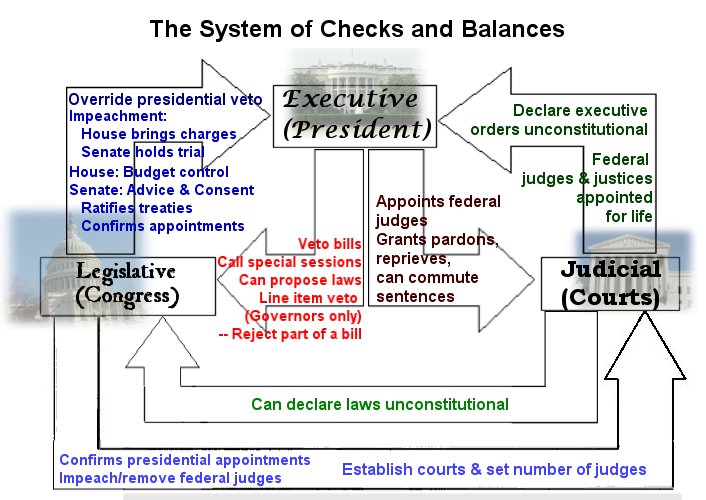
Federalists attempted to ease suspicions over the potential power of the new central government by dividing its authority between three separate institutions. Unfortunately, these mechanisms of checks and balances were borrowed from the British model; a system that required the existence of distinct social classes. For instance, a hereditary monarch was head of state; the upper house of Parliament (House of Lords) represented the nobility; the lower house (House of Commons) represented the moneyed interests. Because these groups were “formally and permanently separate,” each institution had built-in incentives to check the power of the others [6].

In America, however, no such social distinctions existed. There were no monarchs or titled nobility. Land and business opportunities were freely available to anyone with the skills to make use of them. To be sure, there were certainly differences between rich and poor, but with no social barriers preventing an individual from acquiring or losing wealth (unless of course you were a slave), anyone could move between the two classes. As a consequence, although federalist theory attempted to emulate the British government (President=King, Senate=Lords, House of Representatives=Commons), the social homogeneity of American society could not make central institutions inherently competitive.

It was hoped that this theoretical problem could be overcome by “[building] into the mechanism of government itself enough variations on election, powers, term of office, and complication of function to create separate interests and perspectives” [7]. This was reinforced by a Supreme Court, which eventually gained the power to nullify the actions of state and federal behavior. Yet, the major flaw in this approach was that it overlooked the actual competing interests in American society: the planters, the merchants, and the states that represented both. In doing so, the increased power of the central government would be used to subjugate excluded social groups and state institutions to the interests of the ruling faction of the moment.

The planters wanted the central government to stay the hell out of the way (no trade barriers, government subsidies, or permanent military establishments). The merchants, however, wanted to utilize the central government to create business-friendly environments both within the Union and abroad (i.e. protective tariffs, infrastructure subsidies, and a strong military to protect trading interests abroad). The states tended to side with whichever of these groups represented the predominant source of economic activity within their borders--a fact that has divided the Union into regional blocs (North vs. South) ever since.

Thus, over the past two and a half centuries, these theoretical oversights have created bitter political battles for federal power (including one civil war). Starting from the emergence of the Federalists and Democratic Republicans, the sole purpose of national parties has been to impede or prevent the operation of federal checks and balances. This is achieved by ensuring that the individuals occupying federal offices are beholden to interests outside of their respective establishments (so-called "party lines"). This in turn prevents federal institutions from developing different perspectives and interests.

Why, for instance, should the Senate check the decisions of the House if a national party has a majority influence in both? Likewise, Supreme Court Justices are appointed by the President and approved by the Senate based on the ideological principles of the party in power. This is not to say that there are never challenges to particular decisions, but it is usually on the grounds of party politics and not, as Federalists had hoped, the result of institutional rivalry. So long as national parties can prevent the operation of checks and balances on the federal level, there is little point in dealing with state and local governments. As a consequence, without serious revision, American federalism will continue to act as a one-size-fits-all policy machine that ignores the local realities of American communities.

Read more...

Tuesday, June 2, 2009

The Federalist Dilemma part 1: post-Revolution identity


I feel I should explain the central argument of my previous post [1]. Because the US Constitution was developed and implemented in an atmosphere of perceived social anarchy, I maintain that the powers granted to the federal government reveal an overreaction to short-term and inevitable adjustments to independence. The fear of political implosion allowed for a hasty centralization of the means of coercion without a realistic mode of restraining that power. In this installment, I wish to discuss the role of identity in post-colonial America and the problems it created for federalist theory.

To begin, it must be conceded that the American colonies were ill-prepared for self-rule. While this has stirred many a romantic sentiment for the daring and genius of the founding generation, the identity-crisis that followed independence was responsible for much of the instability of the Articles of Confederation. This is because the only real uniting factor among American colonists was their pride in being British. Much of the early contests with Parliament and initial military confrontations with the British army were justified in terms of standing up for British civil rights. Ironically, the Declaration of Independence and the hasty formation of thirteen sovereign states helped to destroy this unity.

First, the problem with overthrowing a central authority—regardless of the justification—is that it sets a precedent for resisting any new authority structure that rises in its stead. There are always winners and losers when it comes to the establishment of a new government [2]. Almost immediately, the new masters have made enemies of those who benefited from the old. Moreover, those who stand to gain from the new regime frequently offer only lukewarm support—hedging their bets in case the former returns.

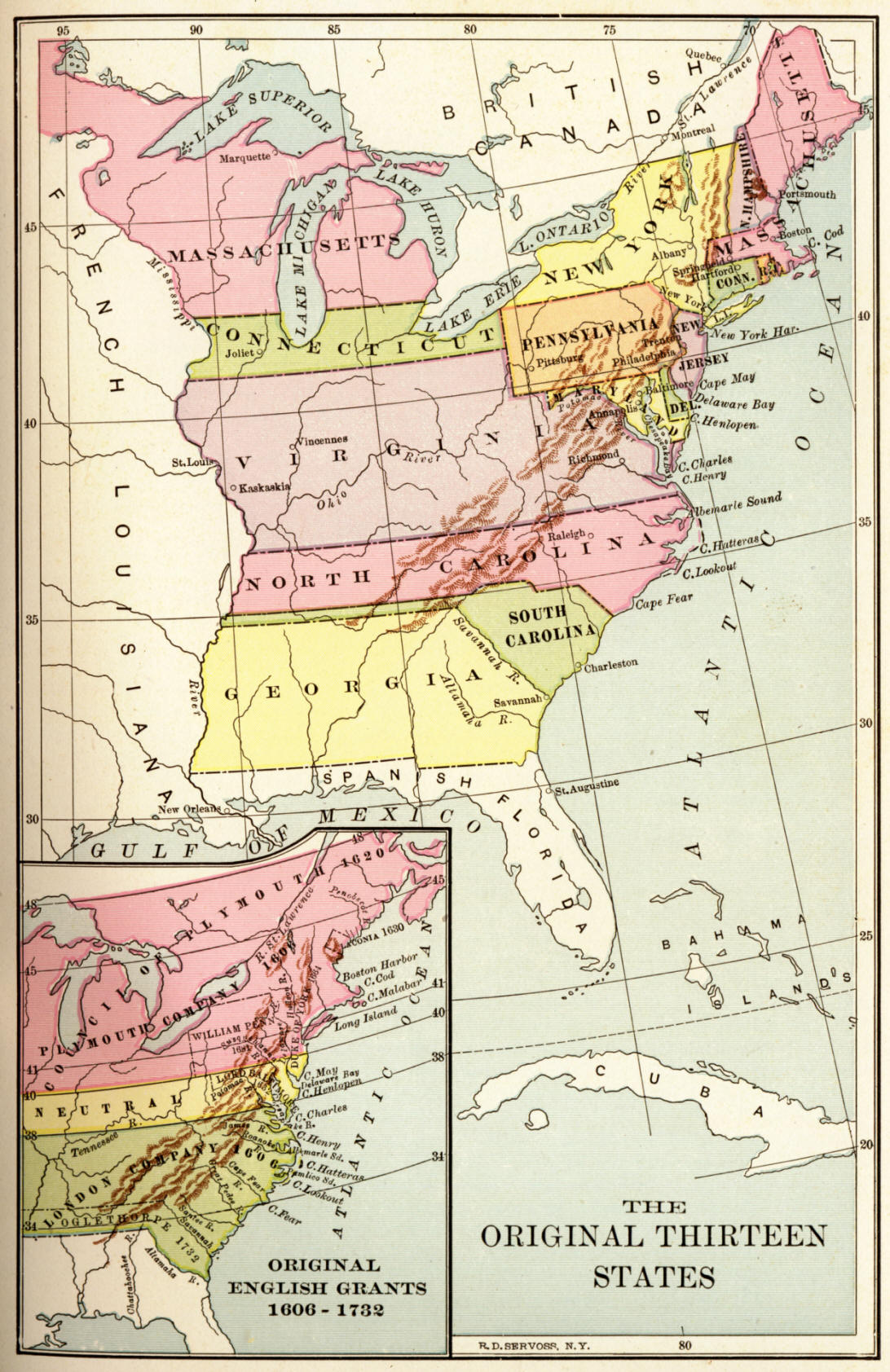
Second, with the general social fabric of colonial society shattered into thirteen separate parts, individual and group identities were forced to reconstitute themselves on the local level. Colonists went from being subjects of a single British identity to citizens of South Carolina, Georgia, Massachusetts, etc. Adding to this was the fact that northern and southern states had divergent economic and cultural interests. The social organization of the former tended to center on trade and manufacturing. The latter was organized around agriculture and cheap slave labor. These regional differences created drastically different views on the role of a central government in foreign and domestic affairs.

In sociological terms, the sudden break-down of authority and social identity created an atmosphere of incipient group-information [3]. That is to say, an “us” versus “them” mentality began to develop in each state even before the Revolutionary War ended. State governments and their citizens were drawn closer to one another through their shared experiences during the war and their dealings with other states. In such a context, the physical and psychological separation of each political community—due in large part to the slow travel and communications technologies of the time—allowed state interests to become disassociated from those of the general. As Edmund Morgan writes in his book, The Birth Of The Republic, esteem for the state governments


and a corresponding distrust of the central government was rising all over the country […] as Congress groped its way down the uncharted paths of national government, the state governments were entrenching themselves behind a growing body of legislation. They were in fact so jealous of their new strength that when Congress finally finished tinkering with [the Articles of Confederation] on November 17, 1777, and presented it to them, they were not at all eager to ratify it [4].


Thus, the Treaty of Paris essentially granted independence to thirteen proto-nations that had quickly developed individual narratives for why the Revolution had been fought [5]. This made for a highly unstable and mutually-suspicious political environment not unlike Renaissance Italy or 18th century Europe [6, 7]. In such a context, the best a central authority could do would be to prevent interstate relations from degenerating into armed conflict or economic warfare. Even within the states themselves, the newness of their authority made it almost inevitable that violent challenges to the new order would occur.

What the Articles of Confederation accomplished was to weather the inevitable growing pains of an ill-conceived independence without degenerating into military dictatorship. It is difficult to believe that the Federal government that replaced it could have done any better. For just two administrations into its existence, threats of secession and foreign conflict prompted the federal government to pass the Alien and Sedition Acts, legislation that teetered dangerously close to authoritarianism.

It could be argued that, with the violence and instability ebbing, the initial call for amending the Articles was far more prudent than throwing out the entire system. Having used only limited and fairly legitimate force (state militias) to establish the authority of the new system, the basic principles of federalism could have been incorporated into existing mechanisms. In my next post, I will discuss how the federalist theory of checks and balances in the new constitution failed to grasp the dynamics of post-war American identity, and undermined the legitimacy of the new system.

Read more...

Saturday, May 30, 2009

The U.S. Constitution: an 18th century Patriot Act?


To be frank, 9/11 scared the hell out of the American public. How could this have happened? Was it part of a larger problem? Could it have been prevented? All of these questions were being asked in an atmosphere of conflicting information and a general feeling of helplessness. As with most crises of this magnitude, advocates for strong leadership—who were perhaps looked upon with ridicule or suspicion prior to that moment—found their way to the forefront of the quick-fix circles. Their solution was fairly standard: strengthen the powers of the central government. This combination of uncertainty and promises of security through consolidation led to the adoption of the Patriot Act —a document now derided in many quarters as the product of fear-mongering and creeping despotism.

What appears to escape the popular imagination is that the federal government itself was established under similar circumstances. Like the Patriot Act, the US Constitution was hastily debated and implemented in the aftermath of a crisis. As such, both the Constitution and the Patriot Act have a few things in common.

First, both documents were meant to correct well-known and legitimate problems with the existing system. According to the Department of Justice, the Patriot Act was intended to update anti-terrorism laws and break down communication barriers between federal agencies [1]. Likewise, the US Constitution was meant to strengthen the central government’s ability to protect Americans from insurrection, interstate rivalry, and foreign intrigue [2].

Second, the crises the Constitution and Patriot Act were meant to address had already been weathered by existing mechanisms. In the case of the former, Shays’ Rebellion had been put down by the Massachusetts state militia and steps were being taken to address the chaos of interstate commerce. Similarly, pre-9/11 institutions had traced the attacks to the Al-Qaeda network and had successfully overthrown the Taliban government in Afghanistan.

Third, the powers granted under both the Constitution and the Patriot Act represented the long-held views of particular interest groups. In 2001, the neo-conservatives—which had been lobbying for a more imperial American foreign policy since the fall of the Soviet Union—painted the 9/11 crisis as an example of federal weakness, countering any opposition to their emergency measures as encouraging further attacks [3]. In 1787, the supporters of the Constitution—known to posterity as Federalists—represented various commercial interests that wanted to recreate British mercantilism. As one anti-federalist writer at the time put it, all the distresses and difficulties [we] experience, proceeding from various causes, have been


ascribed to the impotency of the present confederation, and thence [the people] have been led to expect full relief from the adoption of the proposed system of government; and in the other event, immediately ruin and annihilation [4].


I know what you’re thinking at this point: he’s some sort of anarchist or whack-job conspiracy theorist who hates America. Nothing could be further from the truth. In fact, I think the individuals involved with both documents were just as much patriots as they were politically dangerous. Strength is sexy. It is comforting to think that someone or something has all the answers. But of course they rarely do.

Increasing the power of a central authority also increases the destructive impact of its mistakes and excesses. The Patriot Act, for example, certainly streamlined anti-terrorism tactics, but it has also led to dubious, possibly illegal, federal behavior. All of which previous institutional “barriers” had been erected to prevent. Likewise, the Constitution allowed the thirteen states to speak with one voice abroad, but it also gave rise to a period of military dictatorship (1861-1877) and a consolidated federal empire in all but name [5]. The Articles of Confederation—as flawed as they were—had been designed to prevent the central government from overstepping its bounds in this manner.

I just don’t get the double-standard. The Patriot Act is readily dismissed as the product of an executive power grab. The Constitution, however, is revered as a sacred document bequeathed to us by political geniuses. Both were products of a mix of fear, miscalculation, good intentions, and special interests. Nothing created by man should ever be viewed as sacred or infallible—especially if it was devised and implemented with unusual haste. If change is truly what Americans seek, then they must come to terms with the systemic roots of current dilemmas and reexamine the existing approach to federal union.

Read more...

Thursday, May 28, 2009

Nation-State: the illusion of mass society


Did you know that when France's revolutionary armies invaded Europe, most of its soldiers did not speak French? How is this possible you ask? Well, the primitive state of travel and communications technologies during the Middle Ages meant interactions between villages, manors, and towns, were rare—even among those located in the same kingdom. This physical separation, combined with the passage of time, meant that local dialects could seem like entirely different languages to outsiders.

By the end of the eighteenth century, European states had become centralized clubs for landed elites and were beginning to outlive their usefulness [1,2]. First, over-ambitious monarchs such as Henry VIII, Louis XIV and Phillip II, had either divorced and murdered their way into excommunication or exhausted their state treasuries in dubious wars for personal aggrandizement. This reckless behavior, combined with the fallout from the Protestant Reformation, signaled the end of a unified Latin Christendom.

Second, the means of production began to move away from agriculture to manufacturing. As a result, the burgeoning professional groups that grew out of this new production system could end up wealthier than their aristocratic counterparts. Adding to this was the fact that industrialized production rapidly increased urban populations, creating new lifestyles and political interests that did not easily fit within the existing social fabric.

Although one could easily get bogged down in academic minutiae, the French and American Revolutions basically represented the inability of medieval institutions to address these new realities. By the end of the 19th century, the professional classes, which had chaffed under the constraints of the ancient regime, had either seized control or gained considerable influence in most Western states. They brought with them ideas of using reason and equality to reform governance in favor of all citizens.

Thus was born the idea of the nation. The wealth and power of a state would now be used in the service of the public good. Of course, as individuals such as Robespierre found out far too late, reason is often subjective and the public good is inevitably defined by those in power. More often than not, public schools, central bureaucracies, and mass communications technologies have been utilized to create national sentiments, not reflect them.

If the internet and access to cheap global travel have demonstrated anything in the early years of the twenty-first century, it is that access to information and cross-cultural exchanges will not inevitably lead to a world-wide mono culture. Universal truths (be they religious or secular) and mass societies are manufactured realities, serving the interests of specific social groups. As a consequence, irreconcilable differences in the face of reasoned debate are not necessarily signs of ignorance or political subversion. They simply indicate that geography, history, and local realities will continue to be a source of diverging interests well into the foreseeable future.


Read more...

Friday, May 15, 2009

Reasons of State


Previously, I discussed the origin of the state system in Renaissance Italy[1]. Lacking the legitimacy of tradition or religious sanction, Italian governments were forced to replace social obligation with compulsion. This in turn evolved into a rather violent system of territorial consolidation and expansionism. As the Renaissance wore on, this ad hoc institution was gradually imported by the kingdoms of England, Spain, and France. The question is: what was the pay-off to forcing previously autonomous authority structures into a centralized system of government?

First of all, it is important to understand the relationship between social organization and the means of production. Authority structures tend to evolve around the manner in which food and wealth are produced. During the Middle Ages and the Renaissance, the means of production consisted of rural agriculture and urban merchant trade. Not surprisingly, ownership of land represented the main source of wealth and authority. Control over large tracts of real estate meant one could raise revenue from cash crops, rents, and taxes from urban centers located within a landlord’s sphere of influence.

The problem for medieval monarchs was that control over the means of production was diffuse. Although a king or emperor might have a legitimate claim to rule over his respective realm, his ability to project authority was very limited. First, most authority was local, vested in numerous vassals with their own political and financial interests. Second, the primitive state of roads and other transportation technologies meant that news and armies traveled slowly. This, combined with the ability of local authorities to tax their subjects and maintain military forces of their own, meant that medieval kings had to tread lightly in local matters. Third, the king’s authority rested upon the concept of divine right, bestowed upon him by God’s representative on earth: the pope. Any public break with the Vatican could result in excommunication, a form of religious ostracism that effectively legalized open revolt by a king’s vassals.

In theory, these competing institutions were held together by the common rules and values of their Christian faith. However, as with all social/political arrangements, some individuals tended to end up with more power than others. Those with less inevitably dreamed of getting more (Heroine has nothing on power). Vassals often battled kings and kings had to deflect external encroachments on their regional authority (i.e. popes and other monarchs). Yet, all of this was usually carried out within the moral/legal framework of Latin Christendom.

The only way to truly break this vicious cycle was to step beyond the traditional rules of engagement and that meant using force. The state system offered a way to increase the exterior power of a monarch by consolidating internal legal and production mechanisms. In other words, those who made a king's external policies difficult would have to go. But Unlike their Italian counterparts, European kings could use their traditional authority to justify most of this self-serving ruthlessness.

For instance, trumped up charges of heresy could turn murder or the confiscation of a wealthy vassal's property into the heroic acts of a pious king, defending the sacred institutions of Christendom; a shrewd marital alliance could direct traditionally local revenues into the royal coffers. Increased control over food and wealth production meant a king could pay for his army independently; thus, guaranteeing their personal loyalty. All of these factors served to turn medieval kingdoms into super-statos, whose ability to project military force made them increasingly unresponsive to the constraints of the medieval power structure.

Seen from this perspective, a centralized government enables statesman to exploit a society's military potential. Our modern conception of sovereignty is based on the ability of states to unshackle themselves from external constraints through the threat of violence. This in turn enables the relationship between the government and the governed to be based on practical local realities, as opposed to abstract external narratives. Of course the downside is that interstate relations can often be violent and unpredicatable. Most modern debates on foreign and domestic policies revolve around the trade-offs invoved with mass and local societies; sovereign states vs. regional unions.

Read more...

Sunday, May 10, 2009

A Path To Caesar?


Like so many around the world, I am interested to see the extent to which President Obama pursues criminal investigations into the activities of the previous administration. Of course, the natural inclination for anyone concerned with upholding the rule of law is to call for blood. Judicial recriminations would serve as a deterrent for future administrations and Obama’s re-branding of American foreign policy will create a political environment hostile to any return to the high-handed tactics of the Bush era. America’s reputation as a system governed by laws is restored and the bad guys are punished …so the theory goes anyway.

On strictly moral/legal grounds it is difficult not to side with this line of thinking. Yet, although I am no fan of the Bush Doctrine, I feel as though someone should offer an alternative way of looking at this situation. Humans behave in a manner so far from how morality would dictate that basing public policy on how things ought to be can have serious long-term consequences.

In these United States, the federal government has been entrusted with every means of coercion and legal redress (i.e. the military, police, and federal courts). When a governmental body possesses this kind of monopoly on the use of force, the extent to which it behaves according to its own rules depends on the interests of those wielding its power [1]. Should anything go seriously wrong in Washington D.C., there are very few means by which peripheral governmental institutions, such as the 50 states, could prevent a radical change in federal policy. The question before us is this: with this kind of personal vulnerability, is it really in the interest of the American public to encourage political vendettas at the federal level?

American national politics has become a zero-sum game in which nothing is off-limits, not even the family of a candidate. An individual’s entire life is paraded and scrutinized in front of the world. As a consequence, the acquisition of even the lowest national office is likely to be purchased at great personal cost. This type of vetting process almost guarantees that good men and women shy away.

What remains of the candidate pool often consists of ambitious opportunists, who are just as likely to break the rules as they are to follow them; the deciding factor being how either path affects their position. If history is any guide, when overweening ambition is combined with high-stakes power politics, competition is bound to become personal and the likelihood of the machinery of state being misappropriated increases with every confrontation.

In such an environment, repeated demonstrations of political rivals using their offices to settle old scores increases the personal risks involved with relinquishing power; at some point, someone is likely to feel compelled to go all in. Julius Caesar provides the most famous example of this. His military exploits in Gaul and the die-hard loyalty of his army made him a political threat to the Roman Senate. Fearing his popularity, Caesar was ordered to give up his governorship of Gaul and disband his army.

Although he was a brilliant military strategist, Caesar’s career was built upon immense financial debt and dubious political dealings. If he had disbanded his army, his enemies would have been able to prosecute him under Roman law. True to form, Caesar decided to gamble that his political/military skills would trump those of his opponents; he was right. Caesar’s victory put an end to the Roman Republic and paved the way for one-man rule.

The point I’m trying to make is that so far the United States have been lucky. Law is ultimately an abstract concept, a collection of papers and opinions. What gives legal decisions their teeth is the state’s monopoly on the use of force [2, 3]. Resting so much of that power in so few hands in the federal government is a dangerous arrangement every American citizen should be cognizant of. To date, the men and women we have sent to Washington have largely submitted to the rule of law. Yet, if we set a precedent for post-administration legal actions, how long will it be until they don’t…until they can’t?

Read more...

Saturday, May 9, 2009

Original Gangsters


In my last article we discussed the current state of American political discourse and its unsettling lack of historical perspective. More often than not, the most contentious political disputes center on the role of the state in society. Yet, it is impossible to discuss the role of the state without a fundamental understanding of what it was designed to do. To that end, a basic question must be asked: does the authority of the state ultimately rest on general consensus or coercion? This article will briefly discuss the origin of the state and its implications for public policy.

The modern concept of the state is based on an institution developed in Renaissance Italy known as the stato [1]. Unlike medieval monarchs, who owed their thrones to the Catholic Church and tradition, Italian rulers during this time period acquired their positions through brute force and cunning. Success depended on a government’s ability to placate or suppress conquered populations and expand its rule at the expense of rivals. In such a volatile atmosphere, legitimacy was determined by longevity; statos capable of balancing or neutralizing challenges to their authority (by whatever means necessary) could allow time, stability, and fear to tie subject populations to their regime.

In this sense, the practice of statecraft has more in common with gangsterism than government. Inhabitants of territory brought under the control of a state were intended to serve the interests of those in power, not the other way around. While the rule of law, the administration of justice, and military protection were byproducts of centralized authority, they were merely institutions of expediency. For on the one hand, killing every internal opponent to a regime is impractical; setting a few harsh examples is usually enough to discourage open defiance. On the other hand, providing social stability instills a sense of loyalty and obligation, thus freeing the hand of the ruling faction to concentrate their efforts on external expansion. Substitute words like taxes with protection money or turf with borders, and you may find it quite difficult to distinguish between the activities of Al Capone and Cesare Borgia.

This depiction of the state is not meant to discredit the institution or label it in terms of good and evil. On the contrary, the state has been a highly effective mechanism for political organization over the past four centuries. The point of this discussion is to ensure that, when we are discussing public policy, it is understood that the state is ultimately a coercive institution. It is a political instrument originally designed to enable 16th century thugs to seize and maintain power illegally.

The extent to which such an institution can rest upon the consent of the governed, depends on the social and economic homogeneity of competing factions within its borders. This is not to suggest that states must be racially or culturally "pure" as some have argued in the past. Rather, the more a government is perceived to benefit one or more social groups to the expense of others, the more coercive and illegitimate its authority becomes; exposing the institution's more mafioso roots [2]. As a consequence, taming a state's more violent nature requires a political relationship where "rulers and ruled [can] see, know, and understand each other" [3].


Read more...

Friday, May 8, 2009

Are Our Methods Unsound?


A fascinating thing happened last month. The current governor of Texas, Rick Perry, began using secessionist language in various speeches and interviews to convey his displeasure with the Obama administration. My interest in this recent phenomenon has little to do with his remarks. Rather, the concern is with the media response to the very topic of secession. For instance, in an interview with Tom Delay, Chris Mathews responded to the former congressman’s remarks on the subject with utter abhorrence and a tone of condescending disbelief. After all, everyone knows that the American Civil War proved definitively that secession was illegal…an unthinkable treason. Only a far-right survivalist, praying for the end-of-days could possibly consider threatening the integrity of the American Union….right?

To be fair, Obama is taking the hit for many of his predecessors, moving forward with long overdue and politically divisive reforms for an ailing imperial system. If one wishes to be innovative in the future, it is imperative that existing institutions are stabilized—no matter how antiquated or counterproductive they have become. Whether he gets four years or eight, it will be up to the rest of us to take advantage of the state of flux he leaves in his wake. Furthermore, Governor Perry’s ode to states’ rights smacks of political opportunism; an attempt to energize his more conservative base for an impending and uncertain gubernatorial election.

This brings us to the current state of American political discourse. The Texas governor’s tactics are at the heart of what undermines traditional states’ rights arguments. So long as state autonomy within the Union continues to be associated with the Confederate flag, extremism, and political opportunism, advocates for the more practical aspects of states’ rights will continue to be marginalized with the rest. In my mind, Mr. Mathews’ reaction indicates that conventional battle cries for decentralized governance are unsound and counterproductive. Moreover, attempts to stem the tide of centralization or improve the efficacy of federal governance via national parties have failed and will continue to do so.

In short, there is something fundamentally wrong with the current condition of political thought in the United States. Terms such as nation, state, union, law, and freedom are tossed about with very little thought as to their true meaning or implications. What passes for serious philosophical deliberation consists of talking points, two minute interviews, watered-down campaign slogans, and catchy sound bites. While it is easy (convenient?) to dismiss an in-depth discussion on history and terminology as semantics, anyone who has ever signed a dense legal document for a car or student loan knows that the devil is in the details. Nothing of value can ever be gleaned from such anti-intellectualism. It is time for states' rights advocates to set aside conventional wisdom and articulate a new way forward.

Read more...